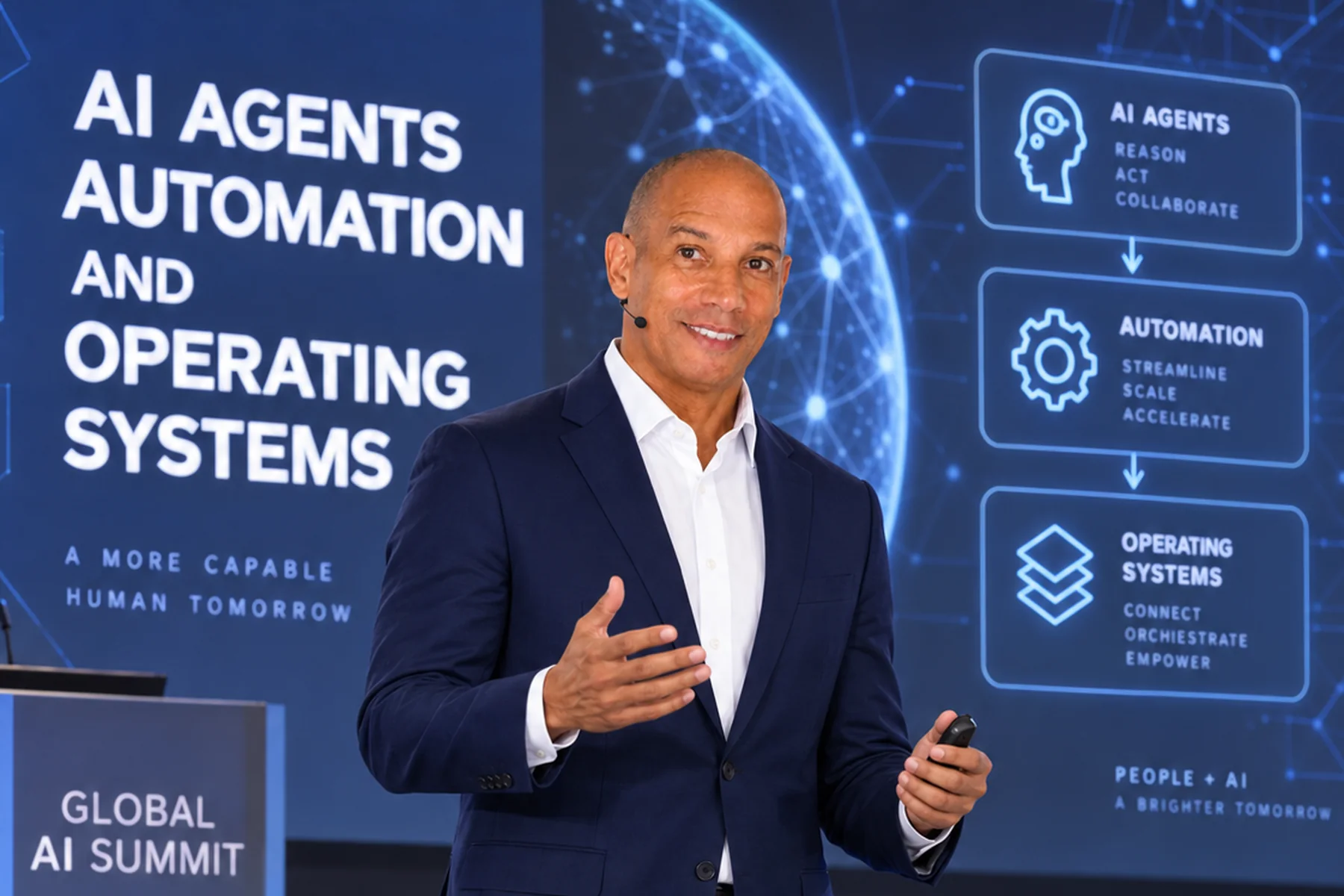
When software begins to understand goals, call tools and coordinate work across systems, the strategic question is no longer only what AI can produce. It is which layer will govern how an organization operates.
On September 10–11, 2026, Valarty brought together a selective group of founders, investors and strategic partners at the Widder Hotel in Zurich, Switzerland, for two days of discussions focused on AI agents, enterprise automation and the emerging operating layer for AI-native organizations.
Approximately 50 invited participants joined the restricted-access session on Thursday and Friday. The scale mattered. This was not a conventional technology conference built around announcements and broad claims, but a compact founder-investor room in which product architecture, enterprise adoption and capital formation could be considered together. Zurich — globally connected, financially literate and attentive to governance — offered a natural setting for that discussion without overwhelming it.
The transition from assistant to agent is not simply an improvement in interface. It is a transfer of operational responsibility: from software that helps a person perform work to systems that can plan, execute, coordinate and supervise portions of the work itself.
From Conversation to Operational Responsibility
The progression discussed in Zurich begins with a chatbot that answers, then a copilot embedded in an application, followed by an assistant that retains context across a broader task. A task-specific agent goes further: it interprets a goal, chooses tools and executes a sequence. Multi-agent workflows divide that work among specialized systems. An enterprise orchestration layer then coordinates agents across departments and software. At the furthest end of the progression sits an AI-native operating system — not a replacement for Windows or macOS, but an organizing layer for institutional activity.
Each step carries a different investment proposition. Chatbots are easy to demonstrate and often difficult to defend. Copilots can inherit distribution from an existing application but may remain a feature. Task agents can own measurable units of work, creating stronger pricing power. Multi-agent systems can address more complex outcomes, but add cost and failure paths. Orchestration layers become strategically valuable when they control permissions, context and the movement of work across systems. An operating layer can become foundational, yet only if reliability and trust grow faster than complexity.
“The defining agentic company will not be the one that automates a single task most elegantly. It will be the trusted coordination layer through which an organization decides how work moves.” — Sancler Requião Barreto, Founder & CEO of Valarty
What Makes a Workflow Agentic
An agentic workflow begins with intent rather than a fixed command. The system must understand a goal, decompose it into steps and decide which applications, APIs or knowledge sources are relevant. It may query customer history, retrieve policy documents, prepare a recommendation, update a record and monitor the resulting outcome. If confidence falls or authority is insufficient, it must escalate to a person. In more advanced architectures, agents collaborate: one gathers evidence, another evaluates risk and a third prepares or executes the approved action.
This distinction is economically important. A conventional automation follows a path designed in advance; an agent can adapt the path to context. The latter can address workflows too variable for traditional rules, but its value depends on disciplined boundaries. Context must persist without becoming stale. Tools must be available without being over-permissioned. Outcomes must be monitored so that an initially plausible action does not produce an operational error several steps later. Autonomy is therefore less a product switch than a controlled allocation of decision rights.
The Enterprise Orchestration Layer
One of the strongest ideas in the room was that agents may coordinate established enterprise systems rather than replace them wholesale. CRM, ERP, human-resources platforms, financial systems, knowledge bases, developer tools, communication channels, procurement software, legal workflows and customer-support systems already hold critical data and rules. The near-term opportunity is to create an intelligent layer above them: one that understands the objective, finds the relevant context and moves work across system boundaries.
The strategic position resembles neither a system of record nor a simple interface. It is a system of action. If a customer renewal is at risk, for example, an orchestration layer might assemble account history from CRM, service issues from support, product usage from analytics, contractual limits from legal records and approval thresholds from finance. It can propose a response, route the exception and execute the permitted steps. The defensible asset is not merely access to each system. It is the logic governing how the systems work together.
Vertical AI and the Value of Context
Horizontal agents benefit from broad applicability and potentially powerful distribution. Vertical agents begin with a narrower market but can encode the language, regulations, exception patterns and economics of one industry. In legal services, value may sit in research provenance, matter context and authorization. In healthcare, clinical workflows and patient-data permissions are central. Finance, insurance and commerce each require their own controls; logistics, real estate, industrial operations and professional services depend on specialized operational knowledge.
That specialization can create defensibility when it produces proprietary workflow intelligence. A model may be available to every competitor, while the sequence by which an organization evaluates a claim, approves a purchase or resolves an industrial exception remains specific. Customer integrations, feedback from completed work and specialized datasets can deepen the product over time. Vertical integration also creates risk: implementation can become services-heavy, the addressable market may narrow and regulatory exposure can grow. Investors must distinguish valuable domain depth from customized software that never achieves repeatability.
Enterprise memory is central to this distinction. Knowledge graphs, retrieval systems and context management allow an agent to reason from institutional history rather than from a generic model response. But memory must respect changing permissions, retention policies and the difference between an authoritative record and an informal conversation. Agent quality may ultimately depend as much on the integrity of organizational context as on model intelligence.
Trust Is the Architecture, Not the Packaging
The deeper an agent reaches into operations, the less governance can be treated as a compliance layer added after product design. Every agent needs an identity, a defined principal on whose behalf it acts, scoped permissions and a record of the tools and data it used. Sensitive actions may require human approval; lower-risk actions may be delegated within limits. Authorization should depend on context — the same agent may be allowed to draft a contract clause but not sign it, recommend a payment but not release it, or resolve a customer case below a defined threshold while escalating the exception.
Auditability must capture more than a final output. Enterprises need to know which sources were consulted, which policies applied, which model or tool was invoked, what changed in a connected system and who retained accountability. Security becomes especially consequential when an instruction can cause action: manipulated inputs, excessive credentials or compromised integrations can travel through an automated workflow at machine speed. Rollback, monitoring, testing and incident review belong inside the product.
This is also where European governance becomes commercially relevant. Risk assessment, activity logging, documentation, human oversight, robustness and transparency are not abstract policy concerns when agents influence consequential workflows. They become procurement requirements and, potentially, sources of advantage. The companies capable of making autonomy legible to security, legal and operational teams may cross the enterprise trust boundary faster than those selling capability alone.
Agent Economics Will Reprice Software
Seat-based SaaS assumes that value scales with the number of human users granted access. Agentic software can reduce the number of people required to perform a workflow while increasing the amount of work completed. That tension pushes pricing toward usage, capacity or outcomes: cases resolved, reports completed, transactions reconciled or hours of work avoided. The vendor begins to look less like a software licensor and more like a provider of digital operating capacity.
Yet outcome pricing does not remove cost. Agents consume inference, retrieval, tool calls, verification and human exception handling. Long workflows can compound both cost and error. Gross margin depends on routing work to the appropriate model, controlling unnecessary steps and ensuring that expensive autonomy delivers economic value. Founders must know the cost per completed workflow, not simply the cost per token. Investors must determine whether revenue expands faster than inference and supervision expense.
Workflow ownership becomes the crucial prize. A company embedded in the path of a high-value process can gain switching costs, proprietary context and opportunities to expand into adjacent workflows. But it must avoid becoming a thin intermediary exposed to foundation-model improvements. Durable advantage may combine integration depth, trusted distribution, embedded approval logic, specialized agents, performance data and network effects created by a growing ecosystem of tools or counterparties.
The Debates Inside the Zurich Room
The session surfaced genuine differences in how the category may develop. One line of argument favored horizontal agents: broad systems could improve quickly, inherit powerful model capability and sit above many applications. Another emphasized vertical specialization, where domain knowledge and trusted workflows may create more defensible positions. Participants also considered whether agents will displace SaaS interfaces or become the primary interface above systems that remain essential underneath.
A related question concerned where value will accrue. Foundation-model providers supply intelligence; orchestration platforms coordinate tools and context; application companies own specific workflows and customer relationships. The likely answer is not a single winning layer. Value will follow control points — distribution, proprietary context, authorization and outcomes — and those control points will differ by market.
Anna Bangert contributed to founder conversations linking European startup ecosystems, cross-border technology companies and the interaction among founders, investors and strategic partners. Her participation helped keep emerging enterprise applications connected to the realities of company building across European markets: fragmented buyers, distinct regulatory environments and the need for trust across borders.
Six Conclusions From Zurich
Agents are becoming a new enterprise software layer. The important transition is from generating content to coordinating action. Companies that reliably connect intent, context and execution can occupy a strategic position above existing systems.
Workflow ownership may matter more than model ownership. Model performance will remain important, but the durable company may be the one that controls the customer relationship, approval logic, integrations and feedback from real work.
Trust and authorization are prerequisites for autonomy. Enterprises will not delegate meaningful work to an agent they cannot identify, constrain, observe and interrupt. Governance is part of the product's utility.
Vertical agents can turn context into defensibility. Specialized data and domain workflows can produce stronger moats than a generic assistant, provided implementation is repeatable and the company can expand beyond one narrow task.
Pricing will move closer to work performed. As software produces outcomes, seats become an incomplete measure of value. Usage and outcome models can align economics, but only when inference, verification and exception costs are understood.
The boundary between software vendor and digital-workforce provider is blurring. Companies that assume operational responsibility will inherit new service expectations, liability questions and margin structures. The opportunity is larger than SaaS; so is the burden of execution.
What Investors Must Underwrite
Agentic AI creates a wide opportunity set and a severe selection problem. Investors should ask whether a product is a feature, an agent or a platform; who owns the workflow and customer relationship; how deeply the system is integrated; and whether proprietary context compounds with use. They should test what happens as foundation models improve: does the company become better and cheaper, or does its differentiation disappear?
Economics and control deserve equal attention. What is the inference cost per successful outcome? Where does human oversight remain necessary? Can the product expand across workflows without making reliability harder to measure? Does the platform preserve gross margin as activity grows? A persuasive demonstration shows capability. An investable company shows repeatable adoption, controlled risk, durable ownership of the workflow and an economic model that improves with scale.
A Different Organizational Architecture
Near the close of the two-day session, Sancler Requião Barreto returned to the wider implication for AI-native companies. If agents can coordinate software, delegate activities, preserve institutional context and operate within defined authority, the result is not merely better enterprise software. It is a different organizational architecture: human employees, software, AI agents and automated processes interacting inside the same governed system.
For Valarty, this reframes the investment question. The objective is not to identify every product that uses agents, but to understand where durable companies can become trusted operating infrastructure. The most consequential platforms may begin with one demanding workflow, earn permission to act and then expand across the organization. Their advantage will be measured not by how autonomous they claim to be, but by how reliably they convert institutional intent into accountable execution.
The Widder Hotel provided an appropriately discreet setting for that conclusion. The Zurich discussions did not assume that an autonomous enterprise is imminent or desirable in every function. They suggested something more precise: as AI moves from assistance toward responsibility, the companies that govern the movement of work may define the next generation of enterprise software.
Research Notes
This post-event analysis distinguishes confirmed event information supplied by Valarty from editorial interpretation. It does not disclose private discussions, attribute statements to unnamed participants or imply investment commitments.
- Anthropic — Building Effective AI Agents
- National Institute of Standards and Technology — AI Risk Management Framework
- European Commission — AI Act
- Hero image: Sancler Requião Barreto during Valarty's September 2026 Zurich session. Photo supplied by Valarty and stored locally; cropped and optimized for publication.
Disclaimer: Content published by VALARTY is for strategic, informational and institutional purposes only. It does not constitute investment advice, an offer to sell securities or a solicitation to invest. Forward-looking observations involve uncertainty and should not be treated as forecasts or commitments.